Remont2025Landing Page & Quote Calculator
Remont
A one-page site and instant quote calculator for a home maintenance contractor in North York. Homeowners pick the work they need and get a fair, itemized estimate on the spot, instead of calling to ask what it costs.
Visit website- Role
- Designer & Developer
- Duration
- Short freelance engagement
- Company
- Remont
- Year
- 2025
- Team
- Kamran Maximoff (Designer & Developer)
- Remont owner (Client)
- Tools

/Context
A local contractor, too many quote calls, and one page to answer them.
Remont is a home maintenance contractor in North York, Toronto, with its own crew: flooring, drywall, painting and minor electrical work, plus design, cleaning and seasonal yard work. In 2025 the owner hired me freelance with a clear brief: a welcoming, modern landing page that introduces the company and its services on one page, and a way for customers to get a quote quickly. I designed and built both, a single landing page with a quote calculator inside it. Nothing else was in scope, and that was deliberate.
/The Problem
Every quote started as a phone call, and most calls needed several more.
Before the site, the only way to find out what a job would cost was to call. The owner was flooded with those calls. Each one started with “how much for…” and turned into a back-and-forth: how big is the room, laminate or hardwood, is the old floor coming out, are baseboards included. It often took several rounds before a prospect would agree to anything, and some never did. That is time on the phone instead of on a job, and there was no way to tell which callers were serious until the work of quoting was already done.
The homeowner is stuck in the same loop from the other side.
If you need a floor replaced, you have no idea whether it is a $1,000 job or a $10,000 job until you have called someone, described the room and waited for a number. Calling to ask a price already feels like a commitment, so it is easy to put off, or to call three contractors and compare numbers that were worked out three different ways. None of that builds trust in whoever eventually picks up.
Both sides were missing the same thing: a number before the first conversation.
The friction wasn’t the phone itself. It was that the price only existed in the contractor’s head, so every customer had to extract it one question at a time. Put a fair price on the page, in the open, and the call that follows can be about booking the work instead of discovering what it costs.
Note
I framed the calculator around trust, not conversion. An estimate only helps if the customer believes it is fair and the contractor is willing to stand behind it. Those two conditions shaped the design more than any layout decision.
/Approach
What, why us, what we do, how much. In that order, on one page.
A homeowner landing on a contractor’s site has four questions, and they come in a predictable order: what is this, why should I trust them, can they do my job, and what will it cost. I used that as the storytelling spine for the page and gave each question its own section, so it reads top to bottom like a short conversation.
- What. The hero says who Remont is and where in one line: residential maintenance and non-structural home improvements in Toronto. The primary button, Get Instant Quote, jumps straight to the calculator for anyone who already knows what they want.
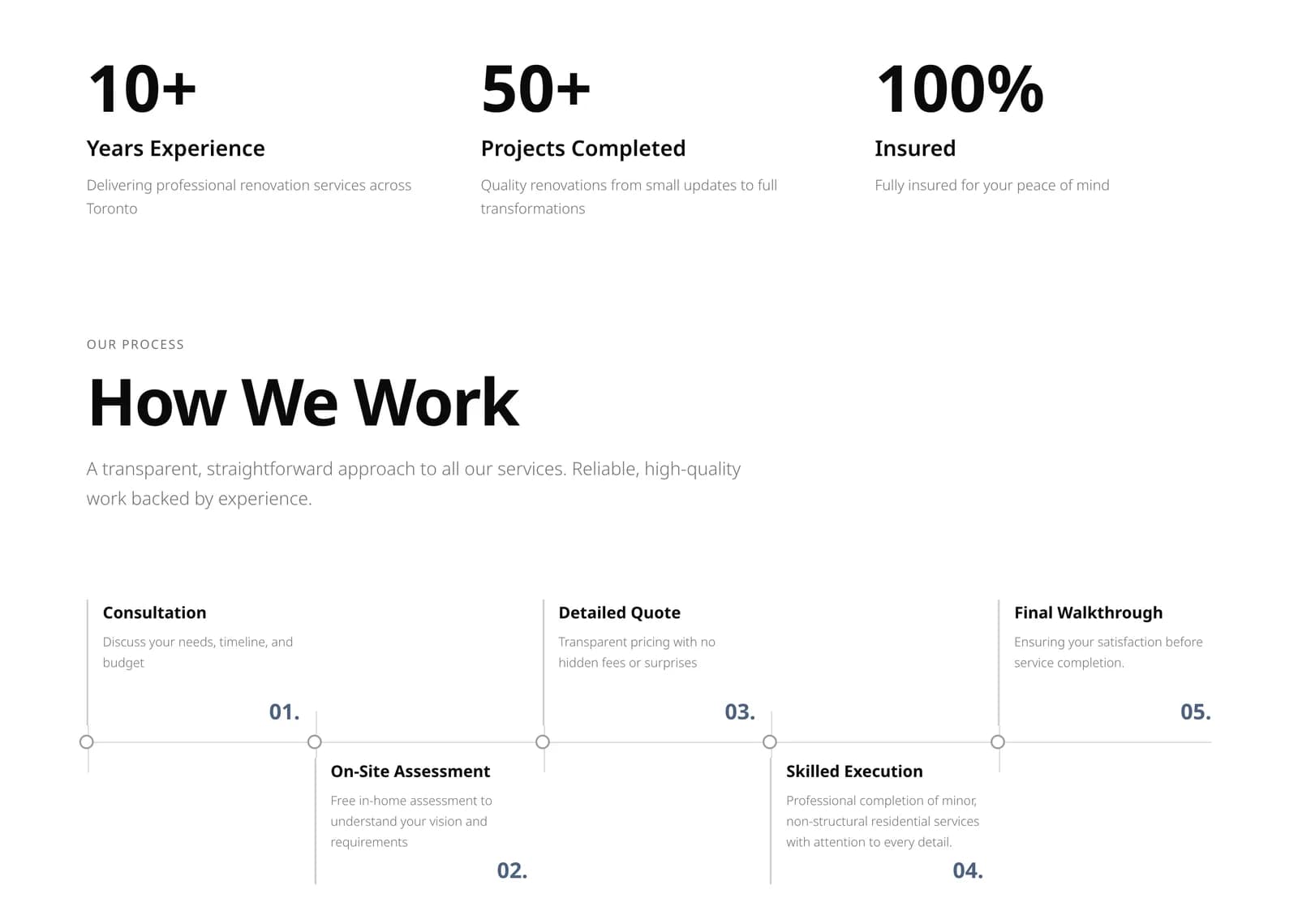
- Why us? Photos of finished work come right after the hero. Later, a band of proof points (experience, projects completed, insurance) sits above a five-step process, from consultation and a free on-site assessment to the final walkthrough.
- What we do. Six service groups, each with a short description and a checklist of exactly what is included, so customers can find their job before they price it.
- How much does it cost? The calculator, followed by a contact form for anyone ready to book.

Why one page
A small contractor doesn’t need a site map. Every extra page is another place for a customer to get lost before they reach a price, and another thing the owner has to keep up to date. On one page, every section is a scroll away from the calculator, and the navigation is three anchors: Services, Calculator, Contact.
“Why us” comes before the price, on purpose.
A number on its own doesn’t build trust; a number from a company you already believe in does. So the page shows real work, the experience behind it and how the job will actually run before it asks anyone to look at a price. By the time customers reach the calculator, the process section has already told them an on-site assessment comes before the final quote, so the estimate reads as a starting point, not a trap.
/The Calculator
Ask in the units the contractor already prices in.
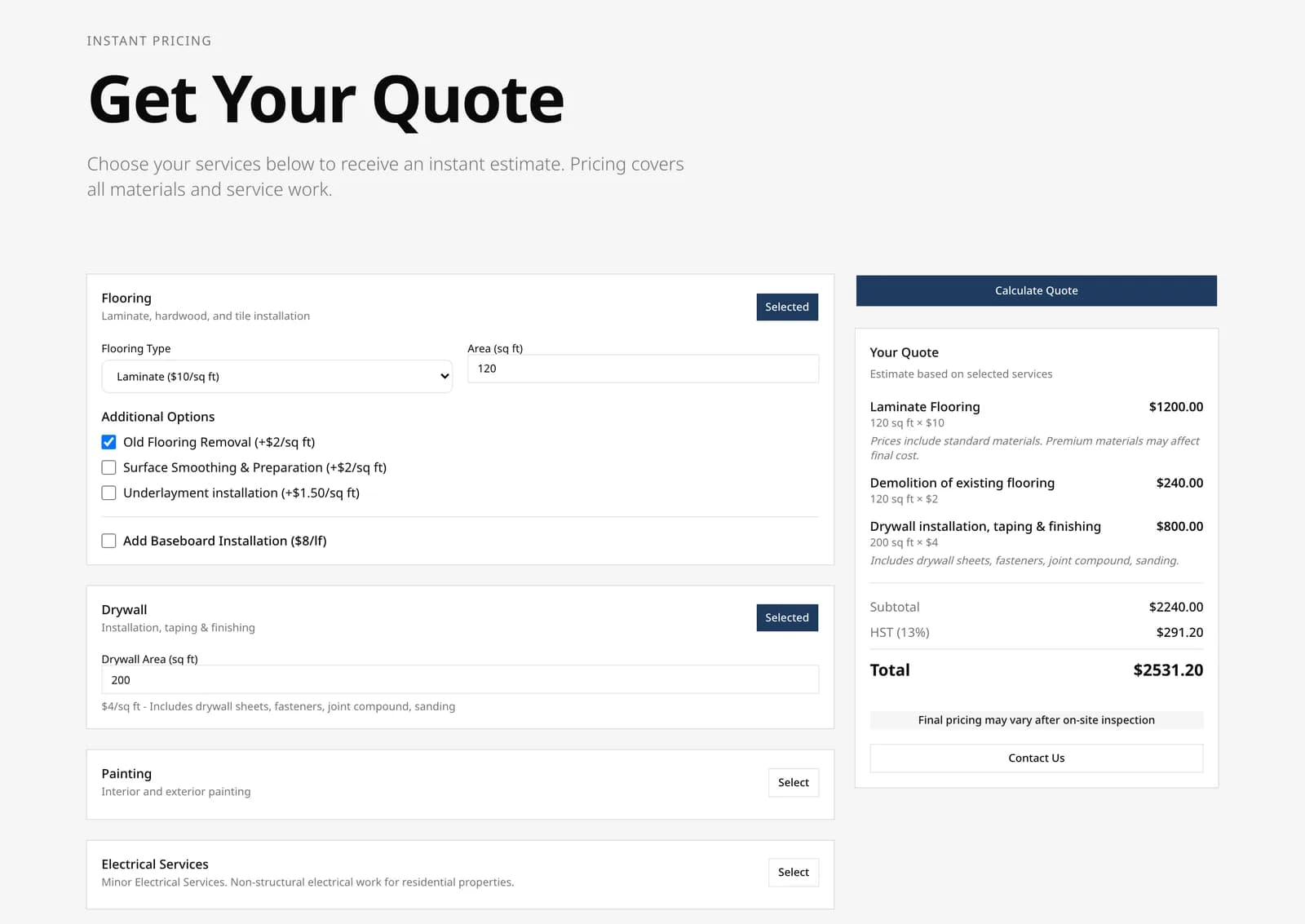
Every service is a card. The customer selects the ones they need, and each selected card opens only the inputs that service is actually priced by. Nothing is asked that the contractor wouldn’t ask on the phone, and nothing the contractor would ask is skipped.
- Area in square feet for flooring, drywall, painting and design work
- Linear feet for baseboards and hedge trimming
- A count per fixture for electrical: bathroom fans, light fixtures, switches, outlets, smoke detectors
- Unit size for cleaning, from a one-bedroom apartment to four bedrooms and up
- Number of visits for lawn mowing, leaf removal and snow removal
- Checkbox add-ons where a job usually has them: removing the old floor, surface preparation, underlayment, baseboards
The rates are the owner’s own rate card, printed on the controls themselves: Laminate ($10/sq ft), Hardwood ($14/sq ft). There is no hidden multiplier between what the customer selects and what the estimate says.
Showing the math is what makes it feel fair.
The estimate isn’t one big number. Every line shows its own calculation (120 sq ft × $10), what it includes and its amount. Below that come the subtotal, HST at 13% on its own line, and the total. A customer can check every number with the calculator on their phone, and that is the point: a price you can verify is a price you can trust, and it is the same rate card for everyone.
- Notes on the lines where the price could move: premium materials for flooring, wiring condition and access for electrical
- Tax shown separately rather than folded in, so the total is what the customer would actually pay
- A plain label under the total: final pricing may vary after an on-site inspection
- A Contact Us button directly under the estimate, for the moment the number looks right
What I chose not to ask for.
The customer sees a price without giving a name, an email or a phone number. No account, no address, no photos, no project description. Gating the estimate behind a form would have produced more leads on paper, but it would have turned the calculator back into the phone call it was meant to replace: tell us who you are first, then we’ll tell you the price.
Note
Where the owner couldn’t commit to a flat rate (mounting and installation, furniture assembly), the calculator lists the service and says so plainly: pricing depends on scope, contact us for a detailed quote. A made-up number there would have been a guess dressed up as an estimate, and it would have cost every other number on the page some credibility.
/On Mobile
The same flow in one column.
On a phone the service cards stack, inputs open in place, and Calculate Quote scrolls the customer straight to an estimate with the same line-by-line math.
/Scope & Trade-offs
One page and a calculator. Everything else stayed out.
The scope was a landing page and a quote calculator, and I kept it there. There is no online booking, no customer accounts, no payments, no CMS and no separate page per service. Each would have been reasonable on its own, but together they would have turned a quick win for a small business into a product the owner had to run.
An estimate, not a final price.
The biggest trade-off is built into the calculator: flat rates can’t see the subfloor or the wiring behind the wall. I didn’t try to hide that. The result is framed as an estimate based on the selected services, the lines most likely to move carry notes, and the process section already promises an on-site assessment before work starts. The calculator was never meant to replace the site visit, only to make sure that by the time it happens, the customer already knows roughly what they are agreeing to.
Copy that only claims what the business does.
A later revision tightened the page so every claim matched the work Remont actually does. “Toronto’s premier contractor” became “Residential property services in Toronto”, “100% licensed” became “100% insured”, services are marked as non-structural, and the footer says plainly that Remont doesn’t do structural renovation or licensed electrical work. On a page whose whole job is trust, an overclaim in the hero would undercut a fair number further down.
/Outcome
What shipped, and what I’d do next.
The site is live at remont.ca: one page, nine services in the calculator, seven of them priced instantly. The intent was simple to state: fewer calls that start with “how much”, and more that start with a number the customer has already seen and accepted.
What I’d do next
- Check the estimates against real invoices. Compare the calculator total with the final price on the first jobs that came through it, and adjust rates or notes where they drift. An estimate is only fair if it is close.
- Carry the estimate into the contact form. Today Contact Us jumps to a blank form, so the customer has to describe the job they just priced. Prefilling the service and attaching the line items would hand the owner a qualified lead instead of another first conversation.
- Let customers keep their estimate. Emailing it to themselves is useful on its own, and it doubles as an opt-in lead the contractor can follow up on.
- Tighten the language. The page says “quote” in some places and “estimate” in others, the removal add-on changes name between the form and the result, and a total to the cent ($2531.20) suggests more precision than a flat-rate estimate has. A range would be more honest.
Note
A small project, but not a small problem. Quoting friction sits between every homeowner and every contractor: the contractor loses hours to prospects who were never going to book, and the homeowner can’t tell what is fair until they have already called around. A transparent estimate up front is the cheapest piece of trust either side can get.
Visit Website
Try the calculator on remont.ca
Pick a service, enter your numbers, and get an itemized estimate in seconds, no phone call needed.
Contact
Have a product that needs designing and building?
I’m available for freelance projects and open to full-time roles. Tell me what you’re working on and I’ll reply within a day.
- Reply within 24 hours 01
- Free first consultation 02
- Clear proposal, pricing and timeline 03